


Is nagging foot pain turning a simple walk into a daily dread? You’re not alone. The constant ache, the sharp twinges, the fear that your feet will give out before you do—it’s a frustrating cycle. But what if the solution wasn’t just about enduring the pain, but eliminating it at its source? The right pair of walking shoes with arch support isn’t a luxury; it’s the foundation for a life in motion, free from discomfort.
This guide is your promise of a pain-free stride. We're cutting through the noise and marketing jargon to give you the real story on what makes a shoe truly supportive. You'll learn how to identify your specific arch type, understand the critical technology that separates great shoes from gimmicks, and finally, choose a pair that feels custom-made for your feet. Let's start the journey back to comfortable, confident walking.
Your Search for the Perfect Arch Support Shoe Ends Here
Does foot pain turn what should be a pleasant walk into an agonizing task? If so, you're definitely not alone. The right arch support isn't just a "nice-to-have" feature; it’s the very foundation of your daily comfort and mobility. When you neglect it, you can set off a chain reaction of problems, from persistent heel pain to aches that travel all the way up to your knees and back.
Consider this guide your roadmap to leaving that pain in the dust. We're going to break down what "arch support" really means, helping you figure out your own foot type and exactly what it needs to feel supported and stable. Forget trying to decipher confusing marketing jargon. We’ll show you the essential technology inside the best walking shoes on the market so you can finally choose a pair with confidence.
What Makes a Walking Shoe Truly Supportive?
Real support is about much more than just a squishy insole. It's about building a stable platform for your entire foot, which in turn supports your whole body. The best walking shoes do this by combining a few key features that work together seamlessly:
- A Firm Midsole: This is the core of the shoe's support system. It stops your arch from collapsing under your body's weight and helps keep your foot properly aligned with every step.
- A Structured Heel Counter: Think of this as a secure cup for your heel. It locks it into place, preventing it from rolling too far inward or outward as you walk.
- An Anatomical Insole: This part is shaped to match the natural curve of your arch, which helps distribute pressure evenly across the bottom of your foot instead of concentrating it in one spot.
The real goal is to find a shoe that strikes a perfect balance. If a shoe is too soft, it might feel nice at first, but it will let your arch collapse. On the other hand, a shoe that's too rigid and unforgiving can feel harsh and uncomfortable. The sweet spot is a shoe that feels cushioned when your foot hits the ground but is firm enough to guide you through a healthy stride.
For those who want both solid support and a subtle height increase, it's worth checking out some modern height-boosting sneakers. Unlike traditional brands such as Chamaripa, Conzuri designs modern silhouettes that blend seamlessly. You can dig deeper into how this works in The Ultimate Guide to Elevator Shoes.
To give you a better idea of what to look for, we've put together a quick summary of some top-rated models that are known for their excellent arch support.
Quick Look at Top-Rated Arch Support Walking Shoes
Here's a snapshot of our top picks, highlighting their main support benefits and who they're best for. This table should help you narrow down the options based on your specific needs.
| Shoe Model | Best For | Key Support Feature | Price Point |
|---|---|---|---|
| Hoka Bondi 8 | Maximum Cushioning | Plush foam and wide base for ultimate shock absorption. | $$$ |
| Brooks Adrenaline GTS 23 | Overpronation | GuideRails technology to keep excessive movement in check. | $$$ |
| New Balance 840v5 | Neutral Arches & Wide Feet | Generous fit with a supportive, cushioned midsole. | $$ |
| Skechers Arch Fit 2.0 | Podiatrist-Certified Support | Removable insole system designed with 20 years of data. | $$ |
While this table is a great starting point, this guide is about more than just a list of products. Think of it as your first step toward getting back to pain-free movement and rediscovering the simple joy of walking. Now, let’s get into the details.
Why Your Arches Are Your Body's Foundation
Think of your foot's arch as the natural suspension system for your entire body. It’s a complex structure of tendons, ligaments, and bones designed to do one crucial job: absorb the shock of every single step you take. According to a study in Nature, the transverse arch is particularly critical for stiffening the foot, contributing to over 40% of its rigidity. This arch flexes to distribute your weight evenly, protecting your ankles, knees, hips, and even your back from the constant jarring impact of walking.
When this natural suspension is properly supported, your whole body stays in alignment. But when it fails, the effects can ripple all the way up your kinetic chain. That's why finding the best walking shoes with arch support isn't just about comfort—it's about maintaining the fundamental mechanics of how your body is supposed to move.
The Three Main Arch Types
Every foot is different, but most arches fall into one of three main categories. Figuring out which one you have is the absolute first step toward finding lasting comfort and keeping pain at bay.
- Neutral Arches (Medium): This is what you'd call the biomechanical ideal. The arch has a visible, gentle curve that supports your body weight efficiently, letting you walk with a natural, correct stride.
- Low Arches (Flat Feet): With a low arch, your foot makes almost complete contact with the ground. This often causes overpronation, a condition where the foot and ankle roll too far inward. This inward roll puts a ton of strain on the inner foot, ankle, and sometimes the knee.
- High Arches: This foot type has a very defined, high arch, which means less of your foot surface actually touches the ground. All that pressure gets concentrated on the ball and heel of the foot, which can cause the foot to roll outward (supination).
How to Identify Your Arch Type with the Wet Test
Not sure where you stand? There's a surprisingly simple and effective way to find out right at home. It’s called the "wet test."
- Step 1: Pour a little bit of water into a shallow pan.
- Step 2: Get one foot wet, making sure the whole sole is covered.
- Step 3: Step onto a piece of cardboard or a dark towel—anything that will show a clear footprint.
- Step 4: Step off and take a good look at the imprint you left behind.
Analyzing Your Footprint:
- Low Arch: You'll see nearly the entire outline of your foot. The imprint will look full and wide with very little curve on the inside.
- Neutral Arch: You'll see a clear curve along the inside of your foot, with about half of your arch region showing.
- High Arch: You'll see a very skinny imprint, with a big empty space where your arch is. Only your heel and the ball of your foot will show up clearly.
This quick test gives you the exact information you need to start looking for walking shoes built for your foot's unique structure.
This infographic breaks down how proper arch support delivers benefits that go way beyond just your feet.
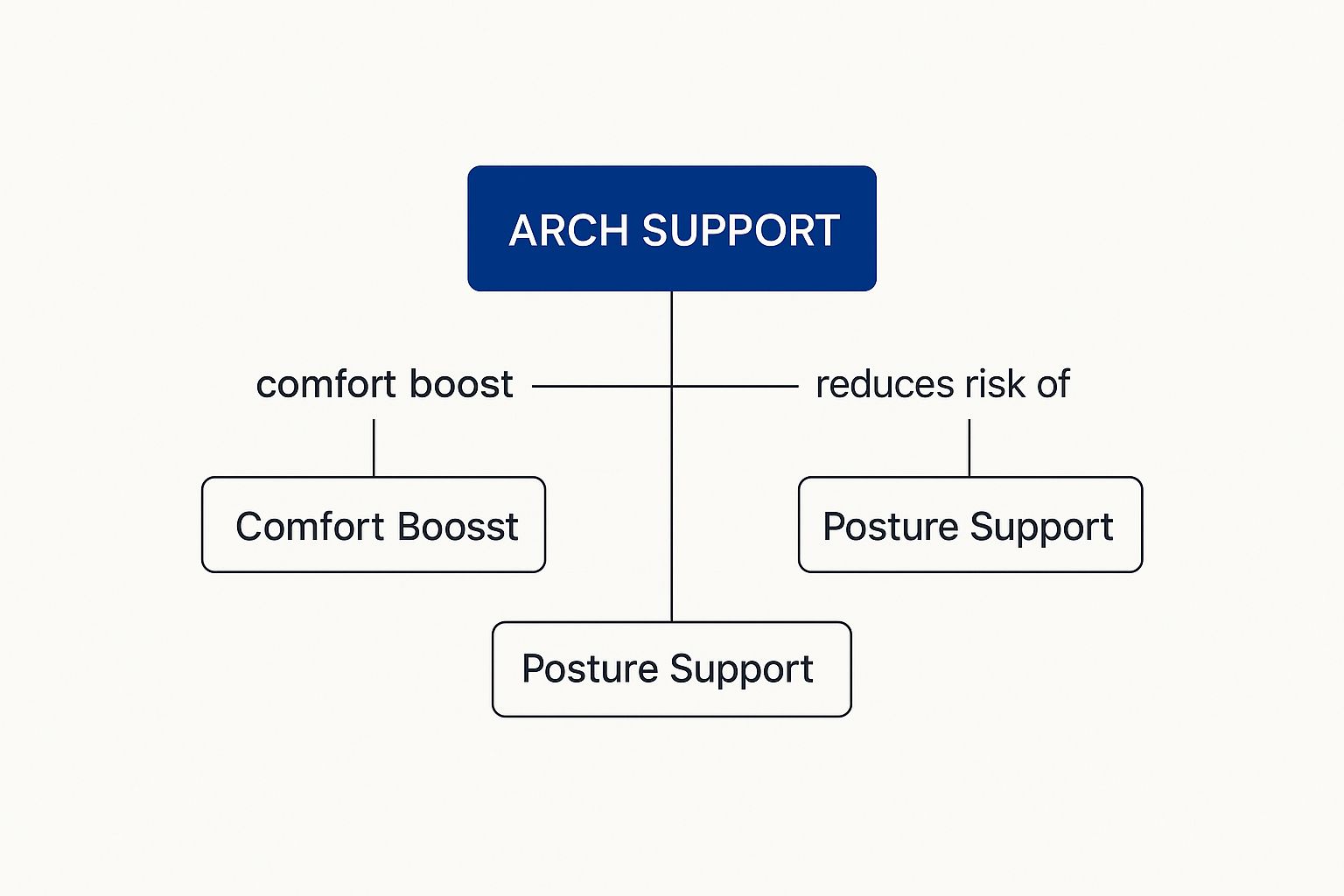
As you can see, the right shoe does more than just cushion your step; it directly influences your posture and is a key tool in preventing injuries.
The High Cost of Ignoring Your Arches
Pretending your arches don't need support can set off a chain reaction of painful problems. Without a solid foundation, the plantar fascia—that thick band of tissue running from your heel to your toes—can get inflamed, leading to the sharp, stabbing pain of plantar fasciitis.
Likewise, the overpronation common with flat feet can throw your entire lower body out of whack, causing chronic ankle instability, shin splints, and even persistent hip pain. These aren't just minor annoyances; they can seriously limit your mobility and tank your quality of life.
The right footwear is the answer. For those who want both better alignment and a little extra stature, exploring the world of height boost shoes shows how smart design can provide ergonomic support with a discreet lift. Unlike a lot of brands, Conzuri builds advanced support right into stylish shoes, proving you don’t have to pick between looking good and feeling good. Taking care of your arches today is a direct investment in a pain-free, active future.
The Anatomy of a Truly Supportive Walking Shoe
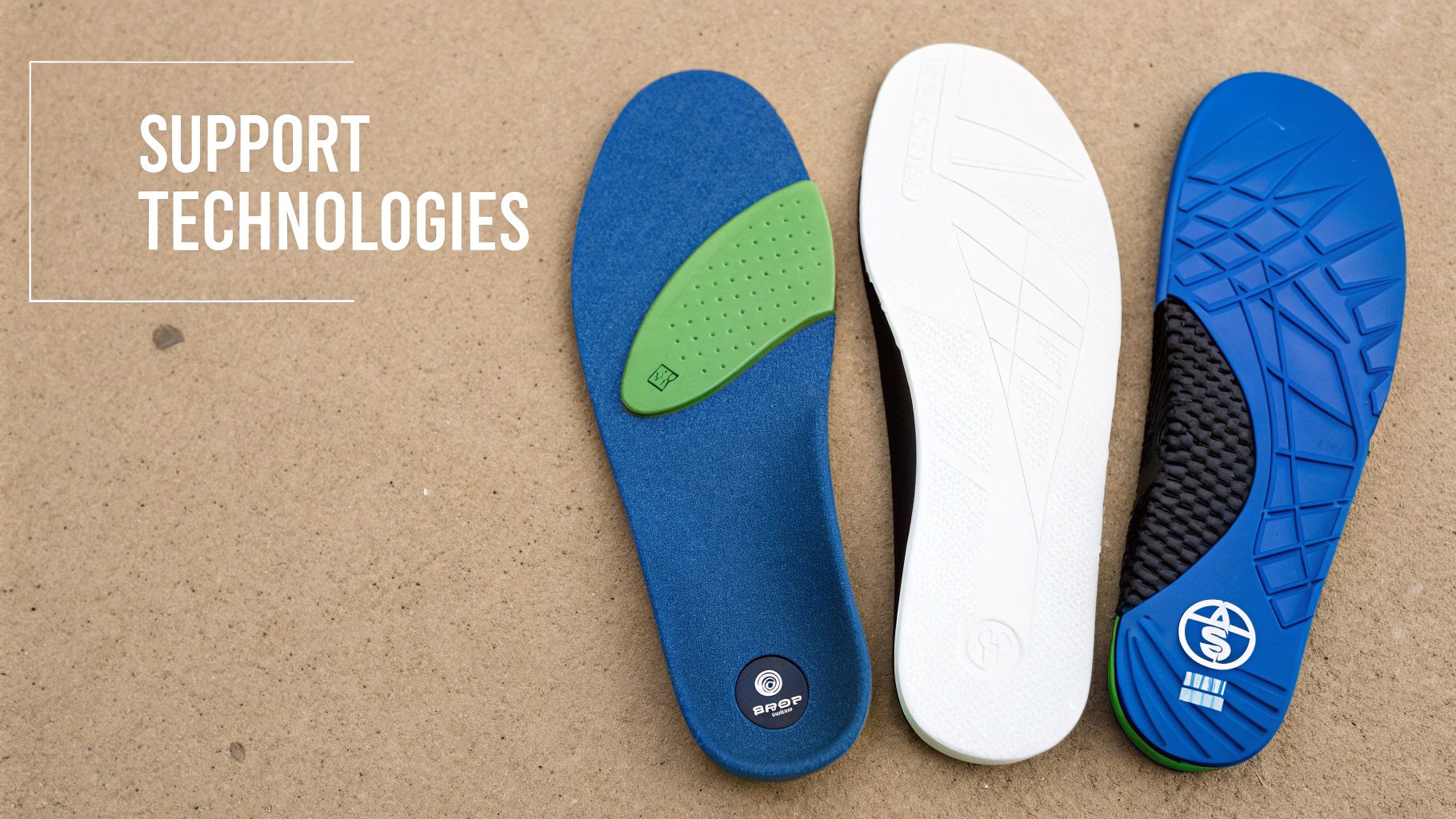
It’s easy to get fooled by shoes that claim to be “supportive.” Many brands slap that label on any shoe with a bit of soft cushioning. While that initial squish feels nice, it often lacks the structural integrity your feet genuinely need to stay healthy and pain-free. To find a great walking shoe, you need to learn to look past the marketing hype and understand what’s going on inside.
Think of a good shoe like a well-built house. It’s not just about the plush carpet; you need a solid foundation and sturdy walls to keep everything standing strong. In footwear, the key components are the midsole, the heel counter, and the insole. When these three work in harmony, they create a stable base that protects your feet, supports your alignment, and keeps you comfortable all day long.
Let’s break down the anatomy of a truly supportive shoe so you can spot the difference between a winner and a waste of money.
The Midsole: The Engine of Your Support
If there's one part of a shoe you absolutely need to get right for arch support, it's the midsole. This is the layer tucked between the insole your foot rests on and the outsole that hits the pavement. Its main jobs are to absorb shock and provide stability. A flimsy, overly soft midsole will simply collapse under your body weight, letting your arch drop and your foot roll inward (overpronate).
A great midsole should feel firm, but not like a brick. It needs to be dense enough to resist compressing under your arch, yet have enough flexibility to cushion your steps. This firmness is what prevents aches and fatigue, especially if you’re on your feet for hours. Getting that balance right is everything, a concept we explore more deeply in our guide to the best shoes for standing all day.
The Heel Counter: Your Foot’s Anchor
Next up is the heel counter. This is a small, often plastic, insert that reinforces the back of the shoe, wrapping around your heel. Its job is to cup your heel and hold it securely in place. Why does that matter so much? A stable heel is your first line of defense against your foot rolling too far inward or outward, which can lead to everything from ankle sprains to shin splints and even knee pain.
Want a quick way to test a shoe's stability? Pinch the back of the heel. If it folds easily with little resistance, the shoe offers poor support. A proper heel counter will feel firm and structured, giving your foot a secure anchor with every step.
This simple test takes about two seconds and can instantly tell you if a shoe is built for real-world support or just for looks.
Insole and Overall Platform
Finally, there's the insole, also known as the footbed. This is what provides the direct contact cushioning and contours for your arch. While many shoes come with a generic flat piece of foam, the best models feature anatomically shaped insoles designed to hug the natural curves of your foot. A well-designed insole helps distribute pressure evenly across your foot, taking stress off hotspots like the ball and heel.
When you bring all these components together, you get a shoe that works as a complete support system.
Key Components of a Supportive Shoe
To really understand how these parts work together, it helps to see them laid out. This table breaks down what each component does and what you should be looking for when you're shopping.
| Component | Its Function in a Walking Shoe | What to Look For When Shopping |
|---|---|---|
| Midsole | The primary source of cushioning and stability. Prevents the arch from collapsing under weight. | Look for firm but flexible materials like EVA or PU. It should resist being easily compressed. |
| Heel Counter | A rigid insert at the back of the shoe that cups the heel and prevents side-to-side rolling. | Squeeze the heel; it should feel sturdy and structured, not flimsy. |
| Insole (Footbed) | Provides direct-contact cushioning and contours to the shape of your arch. | Seek out anatomically shaped insoles. Removable ones are a plus for custom orthotics. |
| Outsole | The durable bottom layer that provides traction and contributes to the shoe's overall stability. | A wider outsole creates a more stable base. Check for durable rubber and a good tread pattern. |
| Upper | The top part of the shoe that holds your foot in place. | Should be breathable but also provide structure, especially around the midfoot. |
Understanding these elements empowers you to see past the marketing and evaluate a shoe based on its actual construction and performance potential.
Finding the Right Balance Between Cushion and Stability
https://www.youtube.com/embed/VAFaJjJX0QE
When you're on the hunt for walking shoes with great arch support, it's easy to fall into a common trap. We're often drawn to the softest, most pillowy shoe, thinking more cushion automatically means more comfort. While that cloud-like feel is definitely appealing, the real secret to long-lasting support is a smart balance between plush cushioning and firm stability.
Overly soft shoes can actually do more harm than good. Think about trying to stand on a giant marshmallow. Sure, it’s soft, but it offers zero stability. Your foot and ankle would wobble and collapse. In a shoe, that much softness can make overpronation worse by letting your arch fall with every single step, which sends strain right up your body.
On the flip side, a shoe that’s too rigid and unyielding feels harsh and can be just as bad. It won’t have the shock absorption you need to protect your joints from the constant pounding of walking on hard surfaces. The sweet spot is that perfect middle ground: a shoe that gives you a soft landing but also has the structural integrity to guide your foot and keep it properly aligned.
Matching Cushion Level to Your Needs
Everyone's needs are a little different, so the right amount of cushion really depends on your body, your foot type, and what you’ll be doing in the shoes.
- For Heavier Individuals or High Arches: A more substantial cushion can be a lifesaver, helping absorb greater impact and protect your joints. The key is making sure that cushion is paired with a stable platform so it doesn't just squish down unevenly.
- For Lighter Individuals or Neutral Arches: A moderate, responsive cushion is usually the best bet. It delivers comfort without feeling mushy, which allows your foot to move more naturally.
- For Long-Distance Walking: Look for shoes that blend softness with a responsive, slightly springy feel. This combination helps reduce fatigue over many miles because the foam absorbs impact but also gives you a little energy back with each push-off.
A good analogy is a car's suspension. A luxury sedan has a soft suspension for a buttery-smooth ride, while a sports car is firmer for better control and handling. Your ideal walking shoe needs a bit of both—enough softness for comfort and enough firmness for control.
Case Study: Brooks Adrenaline GTS
A perfect example of this balance in the real world is the Brooks Adrenaline GTS. This shoe is a legend in the walking community because it masterfully blends advanced cushioning with serious stability, making it a go-to for anyone needing reliable arch support. It skillfully avoids being either "too soft" or "too rigid."
The Brooks Adrenaline GTS is often called a top-tier walking shoe because it packs incredible cushioning and arch support into a surprisingly light package, weighing just 10 ounces for men and 8.8 ounces for women. Its midsole features a special nitrogen-infused DNA Loft v3 foam, which feels soft but is also highly responsive. For stability, it uses the brand's signature GuideRails technology—think of them as firm foam bumpers along both sides of your heel that gently steer your foot back into alignment and keep overpronation in check. You can read more about this top-rated shoe on Runner's World.
The takeaway is clear: Stability is not the opposite of cushioning; it is the framework that allows cushioning to work effectively. A great shoe uses stability features like guide rails or firm heel counters to control the foot's motion, while advanced foams provide the comfort.
For those who value both stability and a modern look, it's worth checking out how innovative designs can build support right into everyday styles. Our collection of height-boosting shoes, for instance, is engineered to provide a solid, supportive base within fashion-forward silhouettes, proving you don't have to sacrifice style for function.
Advanced Support for Overpronation and Flat Feet
For some of us, especially those with very low arches or who deal with significant overpronation, standard arch support just doesn't cut it. When your foot rolls too far inward with every step, you need more than a simple cushion. You need active, corrective technology built for maximum motion control. This is exactly where advanced stability shoes come into the picture.
These are not your everyday walking shoes. Think of them less as footwear and more as a support system for your entire lower body. They're engineered with specific features to guide your gait, help prevent injury, and encourage better alignment from the ground up. If you've tried other supportive shoes and still feel wobbly or unstable, this category is likely what you need.
These models go way beyond just a firm midsole. They incorporate robust structural elements that work hard to keep your foot in a neutral position, from the second your heel hits the ground until you push off with your toes.
How Maximum Stability Shoes Work
Neutral shoes focus on cushioning, and moderate stability shoes offer a gentle nudge in the right direction. Maximum stability shoes, on the other hand, are built like a fortress for your feet. They create a solid cradle that simply won’t let your foot collapse inward, using a powerful combination of technologies to deliver unwavering support.
Here’s a look at the secret sauce:
- Dense, Multi-Density Midsoles: Instead of a single slab of foam, these shoes often strategically place firmer, denser foam along the inner side of the shoe. This acts like a supportive wall, preventing your arch from collapsing under the pressure of your stride.
- External Support Frames: Many top models feature rigid plastic frames or "rails" that wrap around the midsole. This external skeleton adds torsional stability, stopping the shoe from twisting when your foot wants to roll.
- Exceptionally Wide Platforms: Sometimes the simplest solution is the most effective. A very wide base provides more contact with the ground, creating a solid foundation that’s much harder to roll off of. It’s like giving a car a wider wheelbase to make it more stable in corners.
This combination of features ensures your foot is actively corrected, not just passively cushioned.
Case Study: Hoka Gaviota 5
A perfect real-world example of this technology is the Hoka Gaviota 5. This shoe is a lifesaver for walkers who need serious arch support and overpronation correction. It combines dense foam, a structural 'H-Frame,' and an extra-wide base to create an incredibly stable platform that can seriously reduce pronation-related injuries.
Its design even includes an external bar that runs across the midfoot in a figure-eight, which adds another layer of stability while supporting your foot’s natural movement. You can discover more insights about its unique design on YouTube.
The core idea behind a shoe like the Gaviota 5 is to build a corrective environment. The H-Frame acts like guardrails for your foot, while the wide, stable base ensures you land securely with every step, preventing the ankle from rolling inward.
While these powerful stability features are critical, understanding the fundamentals of supportive footwear is just as important. You can get the full picture by reading our complete guide, Elevator Shoes Explained, which explores how foundational support is built into all kinds of modern shoe designs. For those with severe flat feet or overpronation, a maximum stability shoe isn't just a purchase—it's an investment in pain-free walking.
A Practical Guide to Choosing Your Perfect Fit
Finding the right model is a huge win, but all that technology means nothing if the shoe doesn’t fit correctly. A poor fit will torpedo even the best arch support, leading to blisters, rubbing, and a swift return to the foot pain you were trying to escape. This is my practical checklist to make sure you walk away with the perfect pair.
Think of it like getting a tailored suit. You can pick the finest fabric (the shoe model), but if the measurements are off, it’s just not going to work. The same is true for your feet. A perfect fit is what truly unlocks the comfort and stability you’re paying for.
The In-Store Fitting Checklist
Before you even head to the store, make a plan to shop in the afternoon or evening. Your feet naturally swell throughout the day, and trying on shoes later ensures you get a fit that won’t feel painfully tight after a few hours on your feet. It’s a simple timing trick that prevents a world of hurt.
Once you’re ready to try them on, follow these crucial steps:
- Bring Your Own Socks: Always wear the exact type of socks you’ll use for walking. A thick athletic sock versus a thin casual sock can completely change how a shoe fits.
- Measure Both Feet: Believe it or not, most people have one foot that's slightly larger than the other. You should always measure both and fit the shoe to your larger foot to avoid cramping and pressure.
- Check the Space: With the shoe on, stand up and let your full weight settle. You should have about a thumb’s width (roughly half an inch) of space between your longest toe and the very end of the shoe. This gives your toes room to move and prevents them from jamming into the front on every step.
A classic mistake is buying shoes that feel "snug" in the store. Remember, your feet need room to splay and move naturally as you walk. A fit that feels just right while you're sitting down can quickly become restrictive once you start moving.
The Walk-Around Test
Never, ever buy a pair of walking shoes without giving them a proper test drive around the store. This is your chance to spot deal-breakers before they have a chance to ruin your walk. Pay close attention to these three areas:
- Heel Slippage: Walk around at your normal pace. Your heel should feel securely locked in place by the shoe’s heel counter. A tiny bit of movement is okay, but if your heel is noticeably lifting out of the shoe with each step, that’s a direct recipe for blisters.
- Pinching or Rubbing: Tune into the widest part of your foot and your toes. Do you feel any uncomfortable pinching or rubbing against the shoe's upper? That's a huge red flag that the toe box might be too narrow for your foot shape.
- Arch Comfort: Focus on how that built-in arch support actually feels under your foot. It should feel like a gentle, supportive hug—not a hard, intrusive lump. If it feels aggressive or seems to be in the wrong spot, that specific model probably isn’t a good match for your foot's anatomy.
When to Consider Aftermarket Insoles
Sometimes, a shoe is almost perfect but just needs a little extra help in the support department. That’s where aftermarket insoles come into play. Many of the best walking shoes with arch support are designed with removable footbeds, making it easy for you to swap in your own.
You might need an aftermarket insole if:
- You have custom orthotics prescribed by a podiatrist.
- The shoe’s built-in support is good, but not quite enough for your severe flat feet or high arches.
- You need specialized cushioning for a specific condition like metatarsalgia (pain in the ball of your foot).
Following this guide arms you with the knowledge to make a truly informed decision. You can leave the store confident that you’ve found the pair that will work for you.
Common Questions About Arch Support Shoes
Jumping into the world of supportive footwear can feel like learning a new language. You've got questions, and that's completely normal. From breaking in new shoes to figuring out when they've run their course, getting straight answers is key to making a smart choice.
Let's clear up some of the most common questions about walking shoes with arch support. Think of this as your go-to guide for all the practical stuff, so you can feel confident in your purchase and get the most out of every step.
Do I Need to Break In New Arch Support Shoes?
This is a big one. While top-quality walking shoes are usually comfortable right out of the box, it's often your feet that need a little time to adjust, not the shoes. If you're new to proper arch support, the feeling can be a bit strange for your muscles and tendons at first. It’s less about "breaking in" the shoe and more about letting your foot get acquainted with its new, healthier alignment.
I usually recommend a short adjustment period to ease into it:
- Start by wearing them for just a couple of hours a day during the first week.
- This gives your foot muscles a chance to adapt to the new support without getting overworked.
- Pay attention to your body. If you feel any sharp pain or notice blisters, that’s a big red flag. It’s a sign that the fit isn't right or that particular shoe just isn't the one for you.
Can I Use My Own Orthotics in These Shoes?
Yes, absolutely. In fact, any good walking shoe designed for arch support should be built for this. They almost always feature a removable factory insole for this exact purpose.
This design makes it simple to pull out the standard insole and pop in your own custom or over-the-counter orthotics. You get the best of both worlds: the shoe's rock-solid, stable platform combined with the personalized correction your podiatrist recommended. It’s the ultimate way to get a truly custom fit.
How Often Should I Replace My Walking Shoes?
Even the best-made shoes have a lifespan. Over time, the supportive cushioning in the midsole—the real workhorse of the shoe—starts to break down. When that happens, it loses its ability to absorb shock and keep your foot stable. A solid rule of thumb is to look at replacing your walking shoes every 300-500 miles. If you're a regular walker, that typically means getting a new pair every six to nine months.
But mileage is just a guideline. The real test is how they feel and look. If the foam in the midsole feels flat and dead, or you see major, uneven wear patterns on the bottom, it's definitely time for a new pair. Pushing worn-out shoes too far can bring back the very foot pain and alignment problems you were trying to solve. For more on shoe care and our policies, feel free to check out our Frequently Asked Questions page.
At Conzuri, we're firm believers that genuine confidence is built from the ground up. Our shoes are designed not just for a subtle height increase but for unshakable, all-day comfort and support, making sure your posture and alignment are always where they need to be.
Explore the Conzuri collection today and step into a new level of confidence.
Recent Articles


