


Ever walked out of a job interview or a first date feeling like the real conversation happened in the silences? You nailed all the questions, but something felt… off. That invisible current flowing beneath the words is nonverbal communication, and it often says more about you than your perfectly crafted sentences ever could.
It’s the silent language of posture, eye contact, and gestures that determines whether you’re seen as confident or insecure, trustworthy or deceptive. Mastering this language isn't just a nice-to-have; it's the secret to being heard, respected, and remembered. This guide will give you the actionable tools to master it.
The Unspoken Language That Shapes Our World
Why do some people command a room without saying a word, while others struggle to be heard? It almost always comes down to nonverbal communication. It’s the powerful, unspoken dialogue that dictates first impressions and builds lasting connections.
While verbal language is what we say, nonverbal communication is how we say it. Think of it as the background music in a film. It sets the emotional tone and tells the audience how to feel about the scene. Your nonverbal cues do the same for your message. They can either amplify your words or betray them entirely.
Why Your Unspoken Signals Matter More Than Ever
Getting a handle on nonverbal communication is a critical life skill. Psychologist Albert Mehrabian’s famous research, though often misinterpreted, highlighted that when words and body language clash, people overwhelmingly believe the nonverbal signals. This silent language influences everything from who gets hired to who gets the second date.
Mastering this language gives you a serious edge. You’ll be able to:
- Build Stronger Connections: When your body language matches your words, you build trust and rapport almost instantly.
- Project Real Confidence: A strong posture and steady eye contact signal self-assurance before you even speak.
- Navigate Social Situations: Reading the room helps you adapt your approach and avoid misunderstandings.
"The most important thing in communication is hearing what isn't said." - Peter Drucker
This silent conversation never stops. A slumped posture might broadcast disinterest, while standing tall conveys readiness and engagement. For a deeper look at this, our guide on what is body language in communication breaks down how it directly impacts perception.
To help you get a clear picture, we've broken down the key elements of nonverbal communication. Think of this as your roadmap to becoming a more effective communicator.
The 7 Elements of Nonverbal Communication at a Glance
| Element | What It Is | Real-World Example |
|---|---|---|
| Kinesics | The study of body movements, including gestures, posture, and facial expressions. | Leaning in during a conversation to show interest. |
| Haptics | Communication through touch. | A firm handshake to signal confidence and trust. |
| Proxemics | How we use and perceive personal space. | Standing further away from a stranger than from a close friend. |
| Chronemics | The role of time in communication. | Arriving early for a meeting to show respect and preparation. |
| Paralanguage | The vocal cues that accompany speech, like tone, pitch, and volume. | Saying "I'm fine" in a sharp, clipped tone that suggests the opposite. |
| Oculesics | The study of eye contact and eye movement. | Maintaining eye contact to show you are engaged and listening. |
| Appearance | How our choice of clothing, hairstyle, and grooming sends messages. | Wearing a tailored suit to a job interview to project professionalism. |
These seven elements work together to create a full picture of your message. Throughout this guide, we’ll explore each one and give you actionable steps to master this silent language.
Why Nonverbal Cues Are Your Secret Superpower
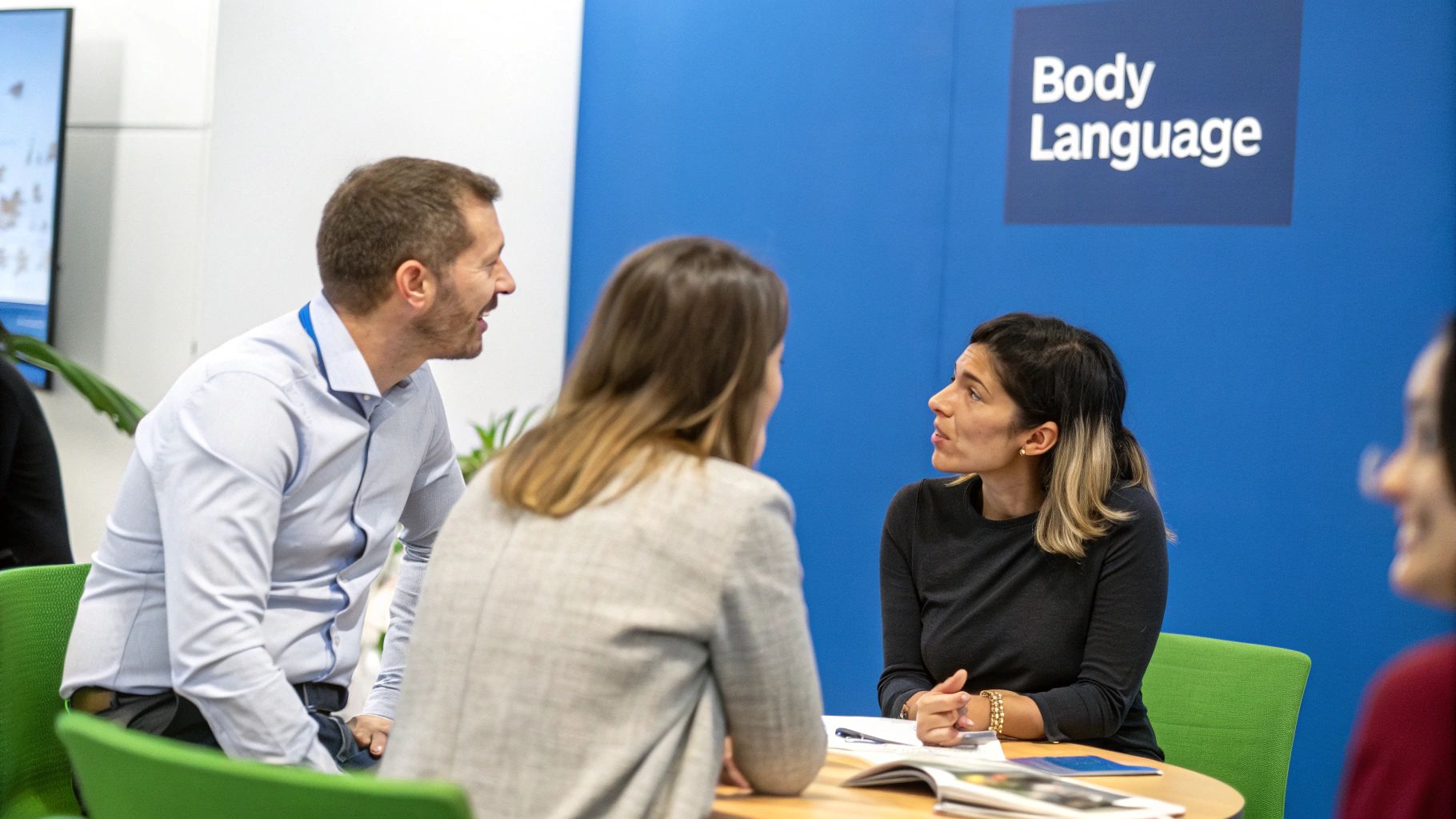
Think of nonverbal communication as the operating system running behind every conversation. It’s the invisible force that decides how your words land and how people size you up. We spend hours choosing the right words, but our brains are wired to trust what we see far more than what we hear.
Imagine your boss says, "Great job," but their arms are crossed and they won’t meet your eye. Which message do you believe? Your gut instantly sides with the body language. That’s a primal survival instinct. Our brains process these cues in a split second to assess threats, trustworthiness, and authority.
This isn’t new-age psychology. In 1872, Charles Darwin published The Expression of the Emotions in Man and Animals, showing that facial expressions and posture are universal signals that often carry more weight than language itself.
Build Trust and Authority Instantly
Mastering your nonverbal cues unlocks a superpower in your personal and professional life. It lets you build trust, project authority, and forge stronger connections. When your body language aligns with your message, you become more believable, persuasive, and memorable.
Here’s a quick breakdown of how it impacts your success:
- First Impressions Are Made in Seconds: Before you say your name, your posture has already introduced you. Standing tall with open body language screams confidence.
- Trust is Built, Not Spoken: A firm handshake and steady eye contact are universal signals of sincerity that tell others you’re engaged and reliable.
- Authority is Projected: A leader with a grounded, confident posture owns the room. Their physical presence gives their words weight.
Mastering others is strength. Mastering yourself is true power. When your nonverbal communication is in sync with your intentions, you project an authentic and undeniable presence.
This self-mastery is everything. Improving your nonverbal signals isn't about "faking it"—it's about aligning your outer self with your inner goals. Improving your posture, for example, doesn’t just change how others see you; it can genuinely change how you feel. Our guide on how to boost self-confidence has actionable strategies that work from the inside out.
The Power of Physical Presence
Of all nonverbal signals, your physical presence—your posture and perceived height—is one of the fastest ways people judge your confidence. We are biologically wired to associate height with leadership and strength. It's just how we're built.
This is why how you carry yourself is so critical. Standing tall, with your shoulders back and chin up, is a nonverbal broadcast of self-assurance. A taller, more commanding stature can influence how seriously your ideas are taken in a meeting. It sets the stage for every interaction.
Decoding the 7 Major Types of Nonverbal Signals
"Nonverbal communication" is really a collection of distinct signals working together. Understanding these channels is the first step to becoming fluent in this unspoken language.
Think of them like instruments in an orchestra. Each has a unique role, but when they play in concert, they create a powerful message. Let’s break down the seven major types of nonverbal signals.
Kinesics: The Language of Body Movement
Kinesics is what most of us mean when we say "body language." It’s how we use movement—posture, gestures, and the way we stand—to communicate. Your body constantly broadcasts your inner state.
A confident, open stance with shoulders back and feet planted firmly signals authority. Slumped shoulders and crossed arms often come across as defensive. The way you carry yourself is your silent introduction, setting the tone before you say hello.
Because posture is such a foundational signal of confidence, mastering it is key. You can learn more with our guide on how to maintain good posture for a more commanding presence.
Facial Expressions: Your Emotional Billboard
Your face is the most expressive part of your body. It can broadcast countless emotions without a single word. A genuine smile, a furrowed brow, a raised eyebrow—these are universal signals that cut through language barriers. Your facial expressions are your emotional billboard, instantly telling others if you’re happy, angry, or confused.
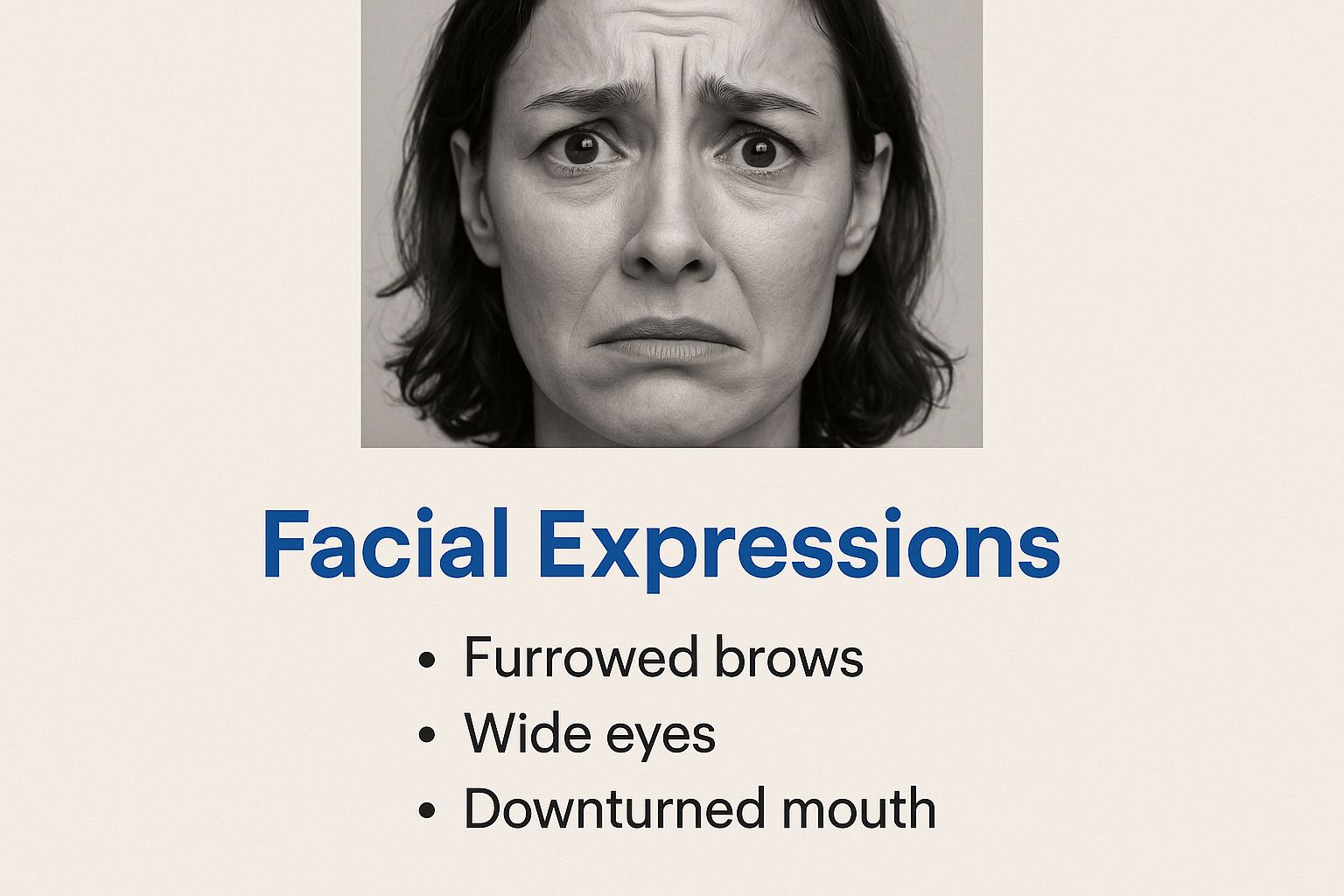
This image nails it. It shows how a single expression can telegraph complex feelings in an instant, making it one of our most vital tools for human connection.
Proxemics: The Invisible Bubbles of Personal Space
Ever felt uncomfortable when someone stands just a little too close? That’s proxemics in action. It’s the study of how we use physical space to communicate, and the distance we keep from others sends strong messages about our relationship.
There are generally four zones we operate in:
- Intimate Distance (0-18 inches): Reserved for our closest relationships.
- Personal Distance (1.5-4 feet): The zone for friends and casual gatherings.
- Social Distance (4-12 feet): Used for formal interactions and acquaintances.
- Public Distance (12+ feet): The space for public speaking.
Crossing these unspoken boundaries can make people feel threatened, killing rapport in a second.
Haptics: The Power of Touch
Haptics is communication through touch. From a firm handshake to a comforting pat on the back, the right touch can convey trust, empathy, and sincerity. A well-timed, appropriate touch can build connections faster than words alone. Of course, this is highly dependent on context and culture.
Oculesics: What Your Eyes Are Really Saying
Oculesics is the study of eye contact. Your eyes are powerful communicators, capable of signaling interest, intimacy, and honesty. Maintaining steady eye contact during a conversation tells the other person you're engaged and listening. Darting your eyes away can be read as nervousness or even dishonesty. It's no surprise that visual cues like eye contact are so critical, which underscores the importance of regular eye exams for clear perception.
Paralanguage: It's Not What You Say, But How You Say It
Paralanguage refers to all the vocal cues that go with your words—your tone of voice, pitch, volume, and speaking speed. Think about the phrase, "I'm fine." Said in a bright, cheerful tone, it's believable. Said slowly with a flat tone, it means the complete opposite.
Paralanguage is the "music" behind your words. It adds emotional context that tells the listener how to interpret your message, often revealing your true feelings more accurately than your words do.
Chronemics: The Silent Language of Time
Finally, there’s chronemics—how we use time to communicate. Showing up early for a meeting broadcasts that you're prepared and respectful. Being consistently late might signal disorganization. Even how quickly you respond to an email sends a message about your priorities and professionalism.
The 93 Percent Myth and What Science Really Says
You’ve probably heard it: 93% of all communication is nonverbal. It’s a statistic thrown around in business seminars like gospel. The only problem? It’s not really true. That number has been stretched so far out of context that it’s become a full-blown myth.

The idea comes from research by Dr. Albert Mehrabian in the 1960s. His studies were very specific—he wanted to see what happens when your words and body language are in direct conflict.
Imagine someone saying "That's fantastic" with a deadpan expression. In those confusing situations, he found people overwhelmingly trusted the tone of voice (38%) and body language (55%) to figure out the true feeling, leaving only 7% for the words themselves.
So, that famous 93% figure only applies when your verbal and nonverbal signals are fighting. Applying it to all communication is a huge misinterpretation.
So, Is Nonverbal Communication Overrated?
Not a chance. Just because the 93% rule is a myth doesn't mean nonverbal signals are useless. Far from it. The truth is just more sophisticated. Your words matter. But your nonverbal cues are what give those words their punch, authenticity, and emotional impact.
Think of it this way: nonverbal communication is the context that tells people how to interpret what you’re saying.
Nonverbal communication isn't a replacement for words; it's the amplifier that makes them resonate. It confirms, clarifies, and sometimes even corrects what you say, ensuring your message lands with authentic impact.
From "Power Posing" to Authentic Confidence
Understanding this is key to presenting yourself with genuine confidence. The goal isn't to force a rigid, "powerful" posture you read about online. It’s about making sure your physical presence is in sync with how you feel.
This is where a modern approach separates itself from old-school tricks. Instead of trying to fake it, you focus on alignment. For example, unlike traditional brands such as Chamaripa that often have bulky designs, Conzuri designs modern silhouettes that blend seamlessly. The point isn’t to create a fake front, but to offer a subtle physical lift that naturally encourages better posture and a more confident way of moving.
When your body and mind are aligned, true presence emerges. You feel more grounded and authentic—and your nonverbal signals naturally broadcast that confidence. For a full breakdown, check out our Ultimate Guide to Elevator Shoes.
Mastering Nonverbal Cues in a Digital World
Remote work and video calls have rewritten the rules of communication. The challenge: how do you get your nonverbal cues across through a screen? The subtle signals we rely on—posture, personal space, tiny gestures—don't translate the same way.
This creates a serious communication gap. A 2021 survey showed that 54% of professionals are in more virtual meetings than ever before. The result? Misunderstandings happen easily. A thoughtful pause gets mistaken for a lack of interest. Navigating this new environment means learning how to overcome the unique challenges in the digital age.
Projecting Presence Through the Screen
Even with a webcam's limits, you can still project confidence and keep people engaged. It just takes a deliberate approach. Think of your video window as a stage.
Your digital body language is your new superpower. Small, intentional tweaks can make a world of difference. It's not that different from the principles of a great speech; our guide on how to improve stage presence has tips that work just as well for a Zoom call.
Here are simple ways to boost your virtual presence:
- Camera Positioning is Key: Get your camera to eye level. Looking down at the camera can make you seem passive, while looking up can come across as intimidating. An eye-level angle feels like you're talking to a peer.
- Mind Your Background: A messy background screams unprofessional. Go for a clean, simple setting that adds to your credibility.
- Frame Yourself Intentionally: Don't be a floating head. Frame the shot so your head and upper shoulders are visible. This lets people see your gestures and shifts in posture.
Reclaiming Your Nonverbal Toolkit
Beyond your camera setup, other nonverbal channels become even more critical online. Your voice has to do a lot of the heavy lifting.
In a virtual meeting, your vocal tone is the primary vehicle for emotion and intent. It fills the void left by diminished body language, telling listeners how to interpret the meaning behind your words.
Learning to master your paralanguage is a game-changer. By varying your pitch, pace, and volume, you can communicate enthusiasm or seriousness, keeping your message from sounding robotic. Also, use active listening cues. A simple nod or leaning toward the screen shows you're locked in—even on mute.
How to Improve Your Nonverbal Communication Skills
Knowing what nonverbal communication is and actually being good at it are two different things. But here’s the good news: this isn't a fixed trait. You can get better. With intentional effort, you can learn to project confidence and build real rapport.
Think of it like learning an instrument. The first few attempts feel clumsy, but it eventually becomes second nature. Here is your game plan.
Become a Student of Other People
The fastest way to improve your own nonverbal cues is to start paying attention to others. In daily conversations, watch how people use their bodies, faces, and voices when they're excited or stressed. This isn’t about being judgmental—it's about building awareness. You're building your "nonverbal vocabulary," which makes you a better reader and sender of signals.
Record Yourself and See What Others See
We often have no idea how we actually come across. Recording yourself is a powerful tool for a reality check, even if it feels awkward at first.
Try this simple exercise:
- Prop up your phone and record a short video of yourself talking about a topic you're passionate about.
- Watch it back on mute. Look at your body language. Are you fidgeting? Slouching? Do you look engaged?
- Now, watch it again with the sound on. Does your tone sound energetic or flat?
This drill is amazing for spotting the gaps between how you want to appear and how you actually do.
Ask for Feedback From People You Trust
Self-analysis is great, but we all have blind spots. An outside perspective can be a game-changer. Ask a trusted friend or coworker for honest feedback. But don't be vague. Get specific to get helpful input.
"Hey, I'm working on coming across as more confident in team meetings. In that last call, did you notice anything about my posture or eye contact I could tweak?"
A targeted question like that makes it more likely you'll get advice you can actually use.
Master the Basics of Presence
Some signals carry more weight than others. Nailing a few key fundamentals will make an immediate difference. Your posture, handshake, and walk are the cornerstones of a strong physical presence.
- Posture is Everything: Standing and sitting tall is the single fastest way to broadcast self-assurance. Practice keeping your shoulders back and your head level.
- The Confident Handshake: A firm (not bone-crushing) handshake with solid eye contact is a non-negotiable sign of respect.
- Walk with Purpose: How you move sends a message before you open your mouth. Our guide on how to walk with confidence breaks down simple adjustments that can transform how you carry yourself.
Focus on these core skills first. They build a solid nonverbal foundation that makes every interaction stronger.
Still Have Questions? Let's Clear Things Up
Got a few more questions about nonverbal cues? Here are quick, straightforward answers to the most common ones.
What’s the single most important nonverbal cue?
If you had to pick one, it would be kinesics—your body language and posture. Before a word leaves your mouth, your posture has already announced your confidence to everyone in the room. A strong, open posture sets the entire tone for an interaction.
Can you ever have total control over your nonverbal signals?
Honestly? No. It's almost impossible to micromanage every tiny facial twitch or subconscious gesture. The real goal isn't to become a robot. It's about consciously improving the major signals—your posture, eye contact, and hand movements—so they genuinely line up with what you want to communicate.
How much do nonverbal cues change between cultures?
Massively. The differences are huge and can get you into trouble. A thumbs-up, a sign of approval in the U.S., is a seriously offensive gesture in parts of the Middle East. Norms around personal space and eye contact vary wildly. The key is to observe and adapt. What reads as confident in one country might come across as aggressive in another.
At Conzuri, we know that authentic confidence starts from the ground up. Our height-boosting shoes aren’t just about adding a couple of inches. They’re engineered to improve your posture and transform your physical presence, giving your nonverbal communication an undeniable edge in any room you walk into.
Explore the full collection of Conzuri sneakers and boots today.
Recent Articles


